(trigger warnings for suicide, both external and internalised trans oppression, parental abuse, religion)
On 28 December, another transgender teenager committed suicide. Statistically, she is likely not to have been the only one in the past month. Leelah Alcorn's suicide note says her parents' response to her assertion of female gender at 14 was to tell her it was "a phase", that "God doesn't make mistakes", and that she "would never truly be a girl", before subjecting her to what is heavily implied to be "reparative therapy". After Leelah turned 16 and her parents Carla and Doug failed to give permission for her to start medical transition, when she publicly "came out as gay" in what she saw as a sort of stepping stone towards social transition, they "took [her] out of public school, took away [her] laptop and phone, and [forbade her from] getting on any sort of social media, completely isolating [her] from [her] friends". By the time they relented enough to let her back in contact with the outside world, her friends had drifted away.
Meanwhile, Leelah had come to the conclusion that she was "never going to transition successfully, even when [she moved] out", no doubt influenced in this by the factual decreased effectiveness of hormone treatment with age - especially in late teens - but also cissexist ideas promoted by the media and the medical establishment of what constitutes "successful" transition, a lack of access to information, thanks to the actions of her parents and "therapists" and the failures of the school system, about how effective such treatment can be even in adulthood, and her parents' abuse. She was also convinced that she would never have enough friends or romance, no doubt influenced by the factual greater isolation transgender people live with on average due to societal transphobia, but also by her parents' and therapists' abuse, her apparent abandonment by the friends she did have, and by a media which promotes a view of transgender people as nothing but punchlines, sex objects, pity objects (and/)or deceivers.
Another suicide victim in recent years whose case has stuck with me is Lucy Meadows. Lucy was a primary school teacher who, when she transitioned over the 2012 Christmas break, was brought to the attention of the local media by transphobic parents such as Wayne Cowie who did not want their attempts to indoctrinate their children with cissexist models of sex and gender to be undermined by contact with an adult whose existence contradicted them. The story was then picked up by Richard Littlejohn, a notoriously bigoted columnist in the more notorious and equally bigoted mass-market Daily Mail. From that point on, she faced paparazzi harassment at every step, and frequently received hate mail.
Although it's unlikely to be recognised as such in the foreseeable future - and indeed the police declared Lucy Meadows' death "not suspicious", which I suppose is technically true only insofar as we know exactly who killed her, how and why - it should be totally uncontroversial to describe their deaths, and others in similar circumstances, as murder. The primary culprits respectively being Leelah Alcorn's parents and "therapists"; and Richard Littlejohn, Daily Mail editor Paul Dacre, Stuart Pike of the Accrington Observer and the editor who approved their original article, Wayne Cowie and the other transantagonist parents who contacted the media in the first place, and others who took part in the campaign against Lucy Meadows as an individual, as well as the financiers who insisted on collecting the debts mentioned in her suicide note.
However, a case can be made that even such transgender suicides that aren't directly traceable to individualised, targeted abuse by specific people are murder, provided they are traceable to generalised oppression. The media is responsible for the perpetuation of transphobic tropes mentioned above - among others - and the lack of role models available to transgender people. The school system is responsible for perpetuating the commonly believed lie that assigned sex is gender, and the lack of both positive understanding of sex, gender, and transgender identities and experiences, and access to information about what's possible with regards to transition. The medical establishment is responsible for putting bureaucratic and legal barriers in the way of people trying to access medical transition, often essential to alleviate frequently crippling dysphoria, and also along with the institution of the family for creating the precedent at birth for each individual trans person to be misgendered throughout their lives until - in the best case scenario - they are able to successfully assert their own identity. All of those things are responsible for creating the environment in which every trans person is subject to a myriad of microaggressions and often macroaggressions such as physical violence and denial of housing, healthcare, work and income. All of those things contribute directly to trans suicide. All of those institutions are, in their continued resistance to improvement after decades of campaigning for change by trans people and worthwhile cis people, wilfully complicit in murder. In genocide.
Mourn the dead.
Fight like hell for the living.
Friday, 2 January 2015

Friday, 21 February 2014
On privilege and responsibility
If you're not subject to a particular form of oppression, then failing to defer to those who are with regards to what is and isn't contributing to that oppression is similar to driving unsupervised in a residential area having never sat in the driver's seat before. You might not hit or directly endanger anyone... but you're unlikely not to, no matter how much it wasn't your intention to do so. Your lack of malice doesn't make anyone you almost hit less traumatised, and it certainly doesn't make anyone you did hit less maimed. If you don't want to endanger anyone, it's your responsibility to get lessons and actually pay attention to the instructor.
To expand the metaphor further...
Imagine traffic laws are either nonexistant or rarely-enforced, and it's unusual for motorists to take lessons at all. Imagine there's no pavements. Imagine the road network is laid out in such a way that you'd be lucky to walk from one town to the next without having to walk on the motorway. Imagine that public transport cost £50 to travel the same distance while only running at all three times a day. Imagine that someone without a car can expect to have multiple "minor" traffic accidents every year and at least one near miss every time they leave the house, and have a 50% chance of being killed on the road by the time they're 35.
In that scenario, would you be surprised to see a #fuckmotorists hashtag? I think you'd be more surprised not to.
To expand the metaphor further...
Imagine traffic laws are either nonexistant or rarely-enforced, and it's unusual for motorists to take lessons at all. Imagine there's no pavements. Imagine the road network is laid out in such a way that you'd be lucky to walk from one town to the next without having to walk on the motorway. Imagine that public transport cost £50 to travel the same distance while only running at all three times a day. Imagine that someone without a car can expect to have multiple "minor" traffic accidents every year and at least one near miss every time they leave the house, and have a 50% chance of being killed on the road by the time they're 35.
In that scenario, would you be surprised to see a #fuckmotorists hashtag? I think you'd be more surprised not to.
Sunday, 27 October 2013
US High School In "Teenage Girl Uses Gender-Appropriate Bathroom" Horror
Florence High School in Colorado has been at the centre of a smear campaign against a trans student led by the misnamed Pacific Justice Institute, who initially claimed that she had been harassing other girls in the school bathrooms. Along with Fox News, various fringe Christian media, and the Daily Mail (which later withdrew its article, but given that it tried to erase any evidence that it ever existed rather than apologising for it and editing the online edition to begin with high-profile clarification that the allegations are unfounded, it seems to me that it this action was motivated by wanting to save face rather than a crisis of conscience), this endeavour has been supported by Cathy Brennan, a lawyer and professional transphobe who describes herself as a "radical feminist" and "lesbian activist" and who is best known for stalking and outing trans* people; Brennan however went a step further, continuing her usual pattern by naming the kid, while users on sites such as Fox News make threats of horrific physical violence including lynching. Interestingly, Brennan's support for PJI has so far been entirely uncritical of their legal actions in defence of "ex-gay therapy" and the homophobic "Defence of Marriage Act" - so much for "lesbian activist".
Since the story first broke, the school superintendent dismissed the notion that any reports of such behaviour had been made, parents of other kids have testified that their daughters have assured them the girl (who for the sake of anonymity has been referred to as Jane Doe) has not caused any problems (one of whom suggested it might be the work of one particular mother with a conservative agenda), and her fellow students and other sections of the local community have rallied to her defence.
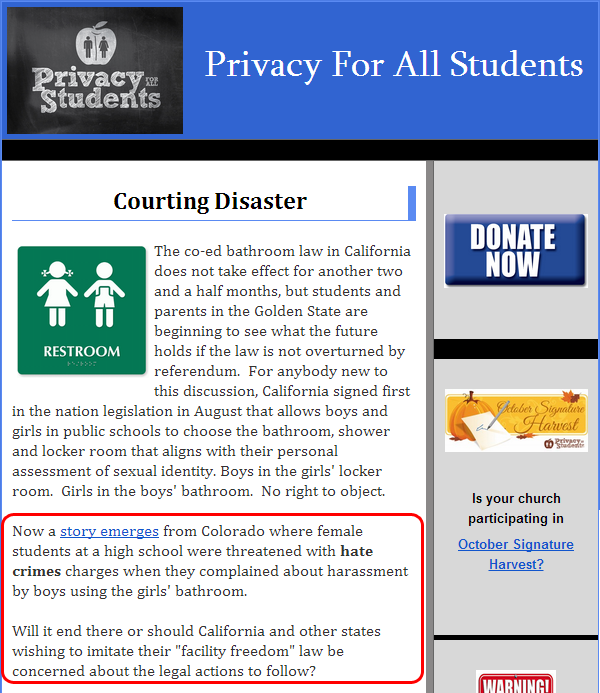
Not that we should be surprised, but it seems that when they can't find evidence - even in the form of anecdotes about isolated cases - to support their favourite narrative that trans people using gender-appropriate facilities endangers cis women (non-trans, to oversimplify it) in public toilets, changing rooms and so forth, whether because trans women ourselves are more likely to be predators or because cis men might pretend to be trans just to access women's spaces, transphobic bigots of all stripes are quite happy to fabricate them, even if they directly destroy the lives of innocent children in the process. Of course, all the while PJI has been using this story in their "Privacy for All Students" campaign against a California law protecting trans* students' civil rights.
In the midst of all this, a young girl's life is being destroyed. It has now emerged that Jane has been placed on suicide watch. The Transadvocate's Cristan Williams has arranged for people to be able to donate to the family to help them deal with Jane's medical and travel expenses, which must be quite significant (see the lack of free healthcare in the US). Please help support them if you can.
Now that the claims of actual harassment have been so thoroughly discredited, Brennan and the PJI have been left arguing that the presence of a trans girl (their phrase was "biological male") in a girls' restroom is "inherently intimidating and harassing" to the other girls using it. They've not stopped their campaign in California of course, so presumably the argument at the core of that campaign is now something like "if the right of teenage girls who are transgender to use the teenage girls' bathroom is protected in law, then teenage girls who are transgender might use the the teenage girls' bathroom!!!!!!111". z0mg.

Since the story first broke, the school superintendent dismissed the notion that any reports of such behaviour had been made, parents of other kids have testified that their daughters have assured them the girl (who for the sake of anonymity has been referred to as Jane Doe) has not caused any problems (one of whom suggested it might be the work of one particular mother with a conservative agenda), and her fellow students and other sections of the local community have rallied to her defence.
Not that we should be surprised, but it seems that when they can't find evidence - even in the form of anecdotes about isolated cases - to support their favourite narrative that trans people using gender-appropriate facilities endangers cis women (non-trans, to oversimplify it) in public toilets, changing rooms and so forth, whether because trans women ourselves are more likely to be predators or because cis men might pretend to be trans just to access women's spaces, transphobic bigots of all stripes are quite happy to fabricate them, even if they directly destroy the lives of innocent children in the process. Of course, all the while PJI has been using this story in their "Privacy for All Students" campaign against a California law protecting trans* students' civil rights.

In the midst of all this, a young girl's life is being destroyed. It has now emerged that Jane has been placed on suicide watch. The Transadvocate's Cristan Williams has arranged for people to be able to donate to the family to help them deal with Jane's medical and travel expenses, which must be quite significant (see the lack of free healthcare in the US). Please help support them if you can.
Now that the claims of actual harassment have been so thoroughly discredited, Brennan and the PJI have been left arguing that the presence of a trans girl (their phrase was "biological male") in a girls' restroom is "inherently intimidating and harassing" to the other girls using it. They've not stopped their campaign in California of course, so presumably the argument at the core of that campaign is now something like "if the right of teenage girls who are transgender to use the teenage girls' bathroom is protected in law, then teenage girls who are transgender might use the the teenage girls' bathroom!!!!!!111". z0mg.
Tuesday, 12 June 2012
Why the "Men's Rights Movement" is misogynistic
Put simply, men are not systemically oppressed. Whilst it's true that most male individuals are oppressed as members of the working class, and might also be oppressed as people of colour, members of sexual minorities, migrants, trans people, disabled people, etc., men as a group are not systemically oppressed.
Women might make assumptions about them or be unduly suspicious of them because of their gender, but this is not systemic oppression and is largely a result of women's oppression. Men might be expected to be promiscuous, dominant, emotionless, physically powerful, but this is a direct cause of women's oppression and oppresses women more than it does men. Men who are seen as "feminine" might be shamed, but this is because femininity is seen as inferior and is therefore even more inseparable from women's oppression.
Now let's look directly at the so-called men's rights movement's flagship issue: the family courts. They cite the alleged bias of child custody cases against the father as an example of "female privilege". I don't have the time to go searching through media reports and statistics which themselves are skewed as often as not and try to sort the fact from the fiction, so I don't know if such a bias actually exists or to what extent... but that isn't the point. If such a bias exists, then in the big picture it's a rational bias in our existing society in which men are all-powerful in sexual and relationship politics. It's taken for granted that men are the active, and usually dominant, partners in any heterosexual relationship... so much so that a lot of heterosexuals see the more active partner in a lesbian relationship as "the man"; this assumption is rarely challenged, and any time the reality deviates from it, society does its best to make it into a badge of shame for both parties. Any woman, particularly a heterosexual woman, who takes charge of her own sexuality is shamed as either a "slut" or a "prude" - often both, as paradoxical as that is. And the contrast between young girls being largely discouraged from any strenuous physical activity and young boys being constantly bombarded with the "need" to be good at running, good at sports, strong in the arm, above all good at fighting, means that the natural physical advantages of most men over most women are even more pronounced. In this context, it's scandalously easy for a man to be both an abusive partner and an abusive parent, and certainly far easier than for a woman. So to campaign for family courts to be "less biased" to women without offering a better solution, whether any individual campaigner is aware of it or not (and I don't doubt that many "men's rights activists" genuinely believe that men are persecuted and are blissfully unaware of their complicity in women's oppression) is to campaign for the last legal recourse of heterosexual women in abusive relationships to be undermined. Any honest campaigner for an equitable family court system should be first and foremost a campaigner for women's liberation.
Every way in which men are "oppressed as men" is inseparable from women's oppression, and can only be solved or mitigated either through women's liberation or by oppressing women further. So every "men's rights activist" who is genuinely not misogynistic should be primarily a women's rights activist. Unfortunately, the "men's rights movement" as a campaigning community almost never mentions women's rights except as a token or in an attack.
Women might make assumptions about them or be unduly suspicious of them because of their gender, but this is not systemic oppression and is largely a result of women's oppression. Men might be expected to be promiscuous, dominant, emotionless, physically powerful, but this is a direct cause of women's oppression and oppresses women more than it does men. Men who are seen as "feminine" might be shamed, but this is because femininity is seen as inferior and is therefore even more inseparable from women's oppression.
Now let's look directly at the so-called men's rights movement's flagship issue: the family courts. They cite the alleged bias of child custody cases against the father as an example of "female privilege". I don't have the time to go searching through media reports and statistics which themselves are skewed as often as not and try to sort the fact from the fiction, so I don't know if such a bias actually exists or to what extent... but that isn't the point. If such a bias exists, then in the big picture it's a rational bias in our existing society in which men are all-powerful in sexual and relationship politics. It's taken for granted that men are the active, and usually dominant, partners in any heterosexual relationship... so much so that a lot of heterosexuals see the more active partner in a lesbian relationship as "the man"; this assumption is rarely challenged, and any time the reality deviates from it, society does its best to make it into a badge of shame for both parties. Any woman, particularly a heterosexual woman, who takes charge of her own sexuality is shamed as either a "slut" or a "prude" - often both, as paradoxical as that is. And the contrast between young girls being largely discouraged from any strenuous physical activity and young boys being constantly bombarded with the "need" to be good at running, good at sports, strong in the arm, above all good at fighting, means that the natural physical advantages of most men over most women are even more pronounced. In this context, it's scandalously easy for a man to be both an abusive partner and an abusive parent, and certainly far easier than for a woman. So to campaign for family courts to be "less biased" to women without offering a better solution, whether any individual campaigner is aware of it or not (and I don't doubt that many "men's rights activists" genuinely believe that men are persecuted and are blissfully unaware of their complicity in women's oppression) is to campaign for the last legal recourse of heterosexual women in abusive relationships to be undermined. Any honest campaigner for an equitable family court system should be first and foremost a campaigner for women's liberation.
Every way in which men are "oppressed as men" is inseparable from women's oppression, and can only be solved or mitigated either through women's liberation or by oppressing women further. So every "men's rights activist" who is genuinely not misogynistic should be primarily a women's rights activist. Unfortunately, the "men's rights movement" as a campaigning community almost never mentions women's rights except as a token or in an attack.
Monday, 11 June 2012
Denying trans kids hormone treatment is child abuse
Yes, you read that right. The hormones released at puberty have a significant impact on bodily development, which in turn has a significant impact on the person's ability to be accepted as the gender in which they identify and to maintain a positive body image (which most people's upbringing connects to fitting into arbitrarily defined boundaries of acceptable appearance for members of their identified gender), both of which factors generally have at least a perceptible impact on quality of life. So treatment is often denied to trans kids and teenagers because the clinics want to make sure they have a good quality of life, apparently... sorry, you've lost me. People sometimes regret transitioning, sure - more people regret not having transitioned earlier in life. If there's conflict between the gender a person has been raised as and the one they declare, then the latter has been declared against everything they've been taught to believe about themselves and in defiance of the persecution they know will result. So it's not been declared lightly, and there should be no question about which is more valid. Without the benefit of a crystal ball, what will a reasonable person judge is best for the child? What the child says is best for the child. Not letting them make that decision isn't a neutral option. Even if you're not forcing unwanted gender norms on them,
if they're approaching or have started puberty then you're forcing
unwanted bodily changes on them, which is frankly even worse cos some of
it is permanent, and all of it is at least semi-permanent. It's child abuse.
Saturday, 13 August 2011
On the riots
On Thursday, 4 August, police in Tottenham, north London, shot and killed a man called Mark Duggan, who they tell us was a cocaine dealer, while supposedly trying to arrest him. They stopped the cab in which he was riding, and told the media that he tried to shoot one of the arresting officers who was protected by his radio, which prompted them to return fire; the Guardian later reported that the bullet found in the radio was police-issue, and that the only other gun found on the scene - not police-issue - had been hidden in Duggan's sock throughout the incident and therefore not only had not been fired but could not even have easily been drawn, which makes the incident a gangland-style execution rather than the tragic results of an escape attempt. Duggan was simply the latest in a long tradition of police killings. In the past 13 years, the police have killed an average of around once every 2 weeks; a total of 333 victims.
This, as well as an apparent police policy of stopping and searching young black people at random with enough frequency that in some communities, getting stopped and searched for the first time is seen as a coming of age event, contribute in inner-city areas to a deep hatred of the police stretching back decades to a time when largely-black neighbourhoods were selectively subject to a permanent police state. Meanwhile, the government's austerity programme has seen Jobseekers' Allowance claimants threatened with being forced to work full-time (on top of the time and effort equivalent to full-time work which they're already expected to put in to looking for a proper job) just to recieve the dole, which works out at between £1.34 per hour and £1.52 per hour for under-25-year-olds and between £1.69 and £1.93 per hour for over-25-year-olds at a time of rapidly rising prices, many benefit claimants increasingly insecure in even the benefits they recieve, council tenants insecure in their tenancies, college students have the Education Maintainance Allowance which in many cases is essential to their family's ability to survive removed and at the same time see any possibility of a university education fly out of sight, and thousands of public sector workers made redundant and tens of thousands more in fear that they could be next, creating a mood of desperation among some layers of the working class and more-or-less universal uncertainty. These are the emotions that would have been running high at Tottenham police station on Saturday 6 August when a peaceful protest against police brutality called by Mark Duggan's family turned violent.
Eyewitness reports suggest that the violence on Saturday began when a policeman took his baton to a young woman with no provocation. This could have been an individual act of violence, which would be consistent with the police culture of aggressiveness which anyone with any significant experience of activism (or even who has watched and read the news with their eyes open over the past few years) can attest to; it could just as easily be part of a concerted police strategy to provoke riots in order to produce a public demand for ever more repressive measures on the part of the state. The latter would be consistent with my own experiences in Manchester on Tuesday; passing through the city centre between around 6 and 7pm, I was suprised (but shouldn't have been) to find an unusually large police presence in Market Street, who were systematically searching shoppers and passersby, seemingly with particular attention to black, Middle Eastern and Asian people and anyone in a hood, police standing guard at arbitrary choke points redirecting people, an unusually large volume of police vehicles patrolling the streets - with their sirens running - and while I was in Piccadilly Gardens around a hundred TAU riot police gathered in full riot gear and simply stood there looking menacing for several minutes before they started patrolling the area looking menacing; of course, none of this did anything to ease the already-high tensions. The extent to which police and/or fascist provocateurs were responsible for violence is as yet unknown, but it is known to be standard police practice for police to infiltrate protests, etc. in order to instigate violence; I suspect that much of the more seemingly-aimless violence, particularly that which was convenient for TV crews, was the work of police infiltrators. Aside from demands for the police to be given greater repressive powers, other effects of the riots which may or may not have been deliberate or desired on the part of the police include a rise in racist sentiment among the general populace (despite the fact that as many of the rioters were white as any other ethnic group), as can be demonstrated by the prevelance of racism in many of the comments on this Facebook page (in particular the responses to this post), and an attempt by elements of the English Defence League to take the next step as a fascist paramilitary force by forming organised vigilante gangs (although apparently only about a dozen people turned up in Manchester so it fell on it's arse, I've got no information about how they fared elsewhere though).
If anyone was in any doubt that the police state has benefited from the riots, this video should put those doubts to rest. This was at a small protest against David Cameron visiting the Manchester BBC to talk about the riots; the police questioned every participant and searched some, with no direct pretext at all. Before the riots, would they really have been able to do something like this without a significant public outcry?
Arrestees have been given rediculous sentences: Ursula Nevin was convicted of handling stolen goods for accepting a pair of shorts looted by someone else, and the police celebrated the five-month sentence; Nicolas Robinson got a six-month jail term for taking £3.50 worth of bottled water from a Lidl, because he "was thirsty". Since the riots dying down, councils have started evicting families of people convicted of offences related to the rioting and looting, which David Cameron has attempted to justify in Parliament by making reference to "bad parenting", whilst parents are increasingly forced to work full-time in order to provide for their families, and at the same time Cameron is cutting childcare services and closing youth clubs. If the government wanted to avoid further violence - which it doesn't - then it wouldn't take the road of punishment. Someone who's been to prison is far more likely to reoffend than someone who hasn't, statistically-speaking. And you can easily see why. A prison stay removes people from everyone they know, costs them their job or disrupts their education, and puts them in a situation where the main currency is contrabrand and you have to be "hard" to be respected (and those who aren't respected are likely to get raped, come shower time). When they come out, there's often nowhere for them to go, they've probably lost their house and their job, all but their family and closest friends might have moved on with their lives (the more likely the longer they've been in prison), a criminal record and/or the gap in their employment history created by the prison stay makes it all but impossible to get a legal job or a house. The only doors open to ex-prisoners are the skills they learnt and the contacts they made inside. And life on the street creates further desperation and also makes what was a small chance of changing your situation microscopic, as applications for jobs and benefits invariably require an address. The hopelessness of life on the street often creates a further downward spiral of dispair, and sometimes crime, as people turn to drugs in order to deal with their situation as best they can, at least in the here-and-now.
This, as well as an apparent police policy of stopping and searching young black people at random with enough frequency that in some communities, getting stopped and searched for the first time is seen as a coming of age event, contribute in inner-city areas to a deep hatred of the police stretching back decades to a time when largely-black neighbourhoods were selectively subject to a permanent police state. Meanwhile, the government's austerity programme has seen Jobseekers' Allowance claimants threatened with being forced to work full-time (on top of the time and effort equivalent to full-time work which they're already expected to put in to looking for a proper job) just to recieve the dole, which works out at between £1.34 per hour and £1.52 per hour for under-25-year-olds and between £1.69 and £1.93 per hour for over-25-year-olds at a time of rapidly rising prices, many benefit claimants increasingly insecure in even the benefits they recieve, council tenants insecure in their tenancies, college students have the Education Maintainance Allowance which in many cases is essential to their family's ability to survive removed and at the same time see any possibility of a university education fly out of sight, and thousands of public sector workers made redundant and tens of thousands more in fear that they could be next, creating a mood of desperation among some layers of the working class and more-or-less universal uncertainty. These are the emotions that would have been running high at Tottenham police station on Saturday 6 August when a peaceful protest against police brutality called by Mark Duggan's family turned violent.
Eyewitness reports suggest that the violence on Saturday began when a policeman took his baton to a young woman with no provocation. This could have been an individual act of violence, which would be consistent with the police culture of aggressiveness which anyone with any significant experience of activism (or even who has watched and read the news with their eyes open over the past few years) can attest to; it could just as easily be part of a concerted police strategy to provoke riots in order to produce a public demand for ever more repressive measures on the part of the state. The latter would be consistent with my own experiences in Manchester on Tuesday; passing through the city centre between around 6 and 7pm, I was suprised (but shouldn't have been) to find an unusually large police presence in Market Street, who were systematically searching shoppers and passersby, seemingly with particular attention to black, Middle Eastern and Asian people and anyone in a hood, police standing guard at arbitrary choke points redirecting people, an unusually large volume of police vehicles patrolling the streets - with their sirens running - and while I was in Piccadilly Gardens around a hundred TAU riot police gathered in full riot gear and simply stood there looking menacing for several minutes before they started patrolling the area looking menacing; of course, none of this did anything to ease the already-high tensions. The extent to which police and/or fascist provocateurs were responsible for violence is as yet unknown, but it is known to be standard police practice for police to infiltrate protests, etc. in order to instigate violence; I suspect that much of the more seemingly-aimless violence, particularly that which was convenient for TV crews, was the work of police infiltrators. Aside from demands for the police to be given greater repressive powers, other effects of the riots which may or may not have been deliberate or desired on the part of the police include a rise in racist sentiment among the general populace (despite the fact that as many of the rioters were white as any other ethnic group), as can be demonstrated by the prevelance of racism in many of the comments on this Facebook page (in particular the responses to this post), and an attempt by elements of the English Defence League to take the next step as a fascist paramilitary force by forming organised vigilante gangs (although apparently only about a dozen people turned up in Manchester so it fell on it's arse, I've got no information about how they fared elsewhere though).
If anyone was in any doubt that the police state has benefited from the riots, this video should put those doubts to rest. This was at a small protest against David Cameron visiting the Manchester BBC to talk about the riots; the police questioned every participant and searched some, with no direct pretext at all. Before the riots, would they really have been able to do something like this without a significant public outcry?
Arrestees have been given rediculous sentences: Ursula Nevin was convicted of handling stolen goods for accepting a pair of shorts looted by someone else, and the police celebrated the five-month sentence; Nicolas Robinson got a six-month jail term for taking £3.50 worth of bottled water from a Lidl, because he "was thirsty". Since the riots dying down, councils have started evicting families of people convicted of offences related to the rioting and looting, which David Cameron has attempted to justify in Parliament by making reference to "bad parenting", whilst parents are increasingly forced to work full-time in order to provide for their families, and at the same time Cameron is cutting childcare services and closing youth clubs. If the government wanted to avoid further violence - which it doesn't - then it wouldn't take the road of punishment. Someone who's been to prison is far more likely to reoffend than someone who hasn't, statistically-speaking. And you can easily see why. A prison stay removes people from everyone they know, costs them their job or disrupts their education, and puts them in a situation where the main currency is contrabrand and you have to be "hard" to be respected (and those who aren't respected are likely to get raped, come shower time). When they come out, there's often nowhere for them to go, they've probably lost their house and their job, all but their family and closest friends might have moved on with their lives (the more likely the longer they've been in prison), a criminal record and/or the gap in their employment history created by the prison stay makes it all but impossible to get a legal job or a house. The only doors open to ex-prisoners are the skills they learnt and the contacts they made inside. And life on the street creates further desperation and also makes what was a small chance of changing your situation microscopic, as applications for jobs and benefits invariably require an address. The hopelessness of life on the street often creates a further downward spiral of dispair, and sometimes crime, as people turn to drugs in order to deal with their situation as best they can, at least in the here-and-now.
Thursday, 10 March 2011
The struggle in Wisconsin
I just sent the following letter to the Manchester Evening News:
"I am disappointed in the MEN's complete lack of coverage of the historic ongoing fight over workers' rights in Wisconsin, where a bill was passed through the state senate today (Thursday) to ban unionisation in the public sector after bei...ng delayed for several weeks by a several thousand-strong occupation of the capitol building which was massively supported on the streets and even briefly joined by police officers in defiance of orders to evict them, and where the local trade union federation recently passed a motion to prepare for a general strike to force the act to be repealed. This is an example we can take inspiration from in Britain. If Manchester Town Hall had been occupied yesterday morning (Wednesday) and the Council had been forced to take the time to consider the option of refusing to pass a cuts budget, it might have started a wave of Council rebellions across the country which could have derailed the government's whole agenda, and a national and ultimately global general strike is the only option which will take us out of the quagmire of governments bought out or held hostage by financial speculators and forced to brutalise public services for private profit."
"I am disappointed in the MEN's complete lack of coverage of the historic ongoing fight over workers' rights in Wisconsin, where a bill was passed through the state senate today (Thursday) to ban unionisation in the public sector after bei...ng delayed for several weeks by a several thousand-strong occupation of the capitol building which was massively supported on the streets and even briefly joined by police officers in defiance of orders to evict them, and where the local trade union federation recently passed a motion to prepare for a general strike to force the act to be repealed. This is an example we can take inspiration from in Britain. If Manchester Town Hall had been occupied yesterday morning (Wednesday) and the Council had been forced to take the time to consider the option of refusing to pass a cuts budget, it might have started a wave of Council rebellions across the country which could have derailed the government's whole agenda, and a national and ultimately global general strike is the only option which will take us out of the quagmire of governments bought out or held hostage by financial speculators and forced to brutalise public services for private profit."
Thursday, 2 December 2010
Spin, damn spin and propaganda
I visited my sister in London yesterday and had the privilege of being able to glance through a copy of the day before's Evening Standard. Here's the highlights of the first 15 pages:
- The front page is an article on the main London student demonstration. The third paragraph starts
"Flares were set off as scuffles broke out. Several schoolgirls were knocked to the ground"
They seem to be implying that the people responsible for the latter weren't the police but, inexplicably, the demonstrators who set off the flares. The article goes on to say that Simon Hardy of the National Campaign Against Fees & Cuts (NCAFC)"admitted he had lost control of the march".
It doesn't quote him directly. I suspect this is because he actually said something about not assuming to have authority in the first place over thousands of people taking autonomous collective action... but of course, that wouldn't sound as good for the right-wing capitalist media. In the printed version of the article, the accompanying picture (the first one in the online version, with the pink smoke) appears to have been motion-blurred to make someone look like he's throwing a punch, who if you look closely is actually just scratching the back of his head. http://www.thisislondon.co.uk/standard/article-23902553-students-tuition-fees-protest-brings-central-london-to-standstill.do
- Apparently, the protesters at Lewisham town hall the night before "had" to be attacked by the Territorial Support Group (TSG), the vicious section of the Metropolitan Police's riot squad best known for killing Ian Tomlinson at the G20 in 2009 and whose predecessors the Special Patrol Group killed anti-fascist activist Blair Peach in 1979, in tag team with horses and dogs. The article which alleges this goes on to repeat the notions that when the police attack demonstrators attempting to exert pressure on the people supposed to be representing them, it is the demonstrators that are responsible for the consequent "violent disorder"; and that people can "trespass" in their own town hall. Then, while pretending there were no injuries among the protesters (I so far haven't seen any reports to the contrary, but I personally find it hard to believe that the heavily tooled-up riot squad came off the worse), it gives details of police injuries including smoke inhalation (with no other mention in the entire article of any smoke, which in addition to apparently being otherwise non-existant also seems to have miraculously left all of the demonstrators uneffected). It then claims that
"The trouble flared after the initial demonstration over student fees and cuts in council services was hijacked by a larger group of protesters."
...protesters against what, if they were a separate entity to the 'initial demonstration? Your guess is as good as mine. http://www.thisislondon.co.uk/standard/article-23902389-riot-squad-is-called-in-as-100-protesters-storm-town-hall-over-pound-18m-cuts.do
- On the page opposite, about 200 words are devoted to
"Party's not over for BNP says Barking film-maker"
The article continues more or less in that vein. It highlights the disenfranchisement of many people from which the BNP benefit, while pointedly ignoring the roots of the issue in unemployment, low wages and housing trouble and the scapegoating of migrants for those problems by propaganda-heavy tabloids such as the Evening Standard itself. http://www.thisislondon.co.uk/standard/article-23902380-bnp-battle-in-barking-is-not-over-warns-film-maker.do - apparently the online version has a different title.
- The 15th page is dominated by a thousand-plus-word piece by the diablo himself, David Cameron, attacking the student demonstrations with straw men, arguments which deliberately miss the point, and general misinformation about the distribution of wealth and the nature of state debt. Under the heading of
"students need to get the facts right"
and the subheading of"the protesters need to know the truth".
http://www.thisislondon.co.uk/standard/article-23902443-before-protesting-students-need-to-get-the-facts-straight.do
Monday, 22 November 2010
Organise! Occupy! Fight for the right to learn!
Around 200 people - mostly new faces - demonstrated against the Browne Review (the New Labour-initiated agenda raising tuition fees to £9000 per year with a minimum of £6000) and the parts of the Comprehensive Spending Review attacking education (the ConDem coalition's trademark public service cuts regime billed at reducing the state deficit but much of which will actually cost money to implement) at Manchester Metropolitan University at midday today. With the demonstration seeming to wind up, the students' union officers and Socialist Workers' Party members monopolising the megaphones appeared to be ignoring the call to initiate an occupation which had been passed democratically by the meetings last week, and it was up to myself, anarchists and others to raise the slogan of occupying; even then, one SWP comrade attempted to divert the demonstration to a meeting to discuss the next direction of the campaign, in the students' union (incidentally, in roughly the opposite physical direction to that agreed at the meetings). Thankfully, the crowd enthusiastically took up the call to occupy, and roughly 150 people piled into the atrium of Geoffrey Manton - the main building of the humanities faculty, which is facing 80% cuts, the worst at MMU. Unfortunately, against my calls to stay and occupy the atrium where we would have had easy access to food and toilets, enough room for everyone to lie down come the night (since the plan had been to attempt to hold the occupation until Wednesday morning and then come out to join the Manchester-wide march as part of the national day of action to save education), and where we would be highly visible to everyone in the building and therefore hopefully grown our numbers significantly, a few comrades effectively dragged us into a small lecture theatre while most of the demonstrators were still coming into the building, which meant that most people couldn't see where we were going and we lost about two thirds of our numbers. In hindsight, perhaps a large lecture theatre would have been better than both the one we occupied and the atrium, since a few veterans of the 2008 occupation of the same building against the massacre in Gaza have since informed me that the atrium had been the initial site of that occupation and had been abandoned as unsuitable.
Over the next hour or so, we lost around another 20 to 30 people, in which time we discussed our demands and the contents of a press release, and made a flyer and petition (the latter basically quoting most of the text from the flyer, and mostly just intended as a talking point to help convince people to join or support the occupation). I'll reproduce the text of the flyer here (my own words), including the demands of the occupation:
Over the next hour or so, we lost around another 20 to 30 people, in which time we discussed our demands and the contents of a press release, and made a flyer and petition (the latter basically quoting most of the text from the flyer, and mostly just intended as a talking point to help convince people to join or support the occupation). I'll reproduce the text of the flyer here (my own words), including the demands of the occupation:
In the aftermath of a protest today by 150 people, 50 people today have occupied a lecture theatre in the Geoffrey Manton building at Manchester Metropolitan University in protest against the cuts to education and the rise in tuition fees, mostly MMU students but also some members of staff, students at the University of Manchester, and members of the public in solidarity with our struggle.
We are demanding:
· The opening of all financial accounts, documents and internal memoranda relating to the functioning of the university to scrutiny by the Students’ Union and the public
· The scrapping of EQAL, management’s plan to increase profits by cutting staff and modules in the guise of ‘simplification’
· No job, department, course or module to be cut, including so-called ‘voluntary’ redundancies which are often achieved by threats
· The scrapping of the ‘Late Campaign’, which involves the disciplining of lecturers who are late for lectures usually as a result of higher workloads, and divides students from them by encouraging them to report lecturers for being late
· Free access for all to the building and facilities
· No academic, civil or legal repercussions for anyone involved in the protest and/or occupation
The fact that we have occupied a lecture theatre in the department facing the most severe cuts—80% funding cuts to the Humanities, Law and Social Sciences faculty.
But we aren’t just occupying to achieve demands. We also want to use the space as an organising and campaigning centre, and as a liberated space for discussion, debate and education.
Join us!
At 5, those of us remaining left the occupied lecture theatre to go to Q&A session with Vice Chancellor John Brooks (who took home a salary of £241k - almost 12 times the average UK income - in 2008/9* and according to Mark Harrison of the Commune £250k in 2009/10** as MMU's Vice Chancellor, not counting the perks that come with the job, the inevitable investment portfolio which usually comes with being wealthy almost by default, or his position on the North West Development Board***, no doubt among similar positions) about the cuts and how they will effect MMU, having prepared in advance a list of suggested questions (courtesy of James O'Leary from Communist Students), and initially intending to replenish the occupation force by occupying the larger basement lecture theatre afterwards with the people who were there, simply by not leaving.
Brooks began the session by re-making a speech he gave to a House of Commons committee on implementing the Browne Review, which he started by praising it for creating a 'free market environment' in education which would apparently provide students with more 'choice'; he later backtracked on this, saying "I agree with you, it's not a free market" (is there such a thing?) when I challenged him that marketised education, which would force students to 'choose' their university and course if any based not on quality, interest, level of challenge, possibilities of personal development and other personal criteria, but on what they believe they would be able to afford, doesn't provide students with more choice. His speech went on to passionately defend the importance of humanities education (history, geography and the social sciences), which seems somewhat at odds with the plans of the MMU management headed by him to implement part of the 40-60% cuts required by the Comprehensive Spending Review by slashing a whole 80% from the teaching budget in MMU's Humanities department.
Most of his 'answers' to the questions from the floor involved evading the subject, waffling and - as above - attempting to humour the asker that he 'agrees' with their concerns. One of the questions involved the presence of a Conservative Party MP on MMU's Board of Governors, and the prospects of removing him. Brooks claimed that because of the Tories having won 36% of the vote in May's General Election (and at least part of that having been solely a rejection of New Labour's having spent most of it's 13 years in government starting wars and cracking down on civil liberties), this would be somehow a denial of the 'democratic process'; others hit back that it's intensely undemocratic for a representative of a government which is cannibalising the education system to be a governor of a university, especially when his government's plans are opposed by the vast majority of the staff and students. Another question regarded his salary, which he avoided by saying that it was available online and most of us probably already knew it (which, to his credit, is true). Unfortunately, I never got a chance to come back on that saying that yes, we were aware that his salary was over £200,000, and that a 90% pay cut would still leave him with an approximately average income, and ask if he would be willing to take the 'sacrifice' of living on the sort of pay that most people do anyway if - as it would - it guaranteed the jobs of several other people who would otherwise be made redundant over 'lack of available funding'. He gave Alex Fountain, students' union Community officer, a verbal promise that the students' union's funding from the university would not be cut; the President Rob Croll, who was co-chairing the event with Education officer Liz Marsh, rightly demanded a written guarantee. Linda Holden, the Associate Secretary of the MMU branch of the public service trade union Unison, made a long speech attacking the Vice Chancellor's dishonesty, the EQAL programme, and his whitewashing of last year's job cuts, which recieved loud applause; he tried to deny that EQAL, which involves cutting the number of modules in a year from 6 at 20 credits each to 4 at 30 credits each and scrapping many of the currently-available modules (as well as cutting contact hours between students and lecturers), hurts the choices available to students, and ignored the observation that the proposals effectively render a large percentage of lecturers redundant, which was no doubt the main motive in constructing the schemes.
At 5:45, after Brooks had been complaining for about 15 minutes of 'tiredness' and with 15 minutes left of the allocated time for the session, Marsh and Croll more or less unilaterally decided to end the meeting, with several people still having unasked questions. I forcibly made the point that someone who makes decisions which effect our lives as closely as his should be accountable to his subjects and shouldn't have any choice about answering our questions, regardless of how 'tired' he is; Croll fobbed this concern off by saying we have to 'keep management on our side', as if they somehow are to begin with.
In the end, we didn't occupy the basement lecture theatre after all, deciding not to raise the issue with security in the room. Instead... we went to the bar.
One positive thing that came out of today's events was the validation of occupations as a democratic method of activism; it showed that only an occupation with the mass active participation and support of those effected by the issue in question can be sustained.
*Page 25 of http://www.finance.mmu.ac.uk/uploads/1/MMU_Fin_stats_08-09_Final.pdf
**http://thecommune.co.uk/2010/07/24/unviable-courses-thanks-to-mmu-cuts/
***Mr C Hardy commenting on http://manchestermule.com/article/mmu-campus-plans-set-to-be-delayedSaturday, 20 November 2010
Beating police repression (and internet censorship) after the student occupation
The following post led to the FITwatch blog being taken offline when the Met Police contacted their hosting company. It is re-posted here (and many other places) because:
The remarkable and brilliant student action at Millbank has produced some predictable frothing at the mouth from the establishment and right wing press. Cameron has called for the "full weight of the law" to fall on those who had caused tens of thousands of pounds of damage to the expensive decor at Tory party HQ. Responsibility is being placed on "a violent faction", after the march was 'infiltrated' by anarchists.
There are an encouraging number of initiatives to show solidarity with the arrested students - something that is vital if they are to avoid the sort of punitive 'deterrent' sentences handed out to the Gaza demonstrators. A legal support group has been established and the National Campaign against Cuts and Fees has started a support campaign. Goldsmiths lecturers union has publicly commended the students for a "magnificent demonstration".
This is all much needed, as the establishment is clearly on the march with this one. The Torygraph has published an irresponsible and frenzied 'shop-a-student' piece and the Met are clearly under pressure to produce 'results' after what they have admitted was a policing "embarrassment".
51 people have been arrested so far, and the police have claimed they took the details of a further 250 people in the kettle using powers under the Police Reform Act. There may be more arrests to come.
Students who are worried should consider taking the following actions:
If you have been arrested, or had your details taken - contact the legal support campaign. As a group you can support each other, and mount a coherent campaign.
If you fear you may be arrested as a result of identification by CCTV, FIT or press photography;
DON'T panic. Press photos are not necessarily conclusive evidence, and just because the police have a photo of you doesn't mean they know who you are.
DON'T hand yourself in. The police often use the psychological pressure of knowing they have your picture to persuade you to 'come forward'. Unless you have a very pressing reason to do otherwise, let them come and find you, if they know who you are.
DO get rid of your clothes. There is no chance of suggesting the bloke in the video is not you if the clothes he is wearing have been found in your wardrobe. Get rid of ALL clothes you were wearing at the demo, including YOUR SHOES, your bag, and any distinctive jewellery you were wearing at the time. Yes, this is difficult, especially if it is your only warm coat or decent pair of boots. But it will be harder still if finding these clothes in your flat gets you convicted of violent disorder.
DON'T assume that because you can identify yourself in a video, a judge will be able to as well. "That isn't me" has got many a person off before now.
DO keep away from other demos for a while. The police will be on the look-out at other demos, especially student ones, for people they have put on their 'wanted' list. Keep a low profile. (Re-poster's note: I recommend this one for people who have been arrested already and let off/cleared/fined as well. I stayed away from anti-fascist demos for about 6 months after my arrest recounted in a previous post. It's well-documented that police at demonstrations carry lists of the names and photos of potential 'troublemakers', and having been recently arrested at a demo on the same issue is as good a way as any to get on the list)
DO think about changing your appearance. Perhaps now is a good time for a make-over. Get a haircut and colour, grow a beard, wear glasses. It isn't a guarantee, but may help throw them off the scent.
DO keep your house clean. Get rid of spray cans, demo related stuff, and dodgy texts / photos on your phone. Don't make life easy for them by having drugs, weapons or anything illegal in the house.
DO get the name and number of a good lawyer you can call if things go badly. The support group has the names of recommended lawyers on their site. Take a bit of time to read up on your rights in custody, especially the benefits of not commenting in interview. (Re-poster's note: I assume they mean this support group (click), but I can't find a list of lawyers...)
DO be careful who you speak about this to. Admit your potential or actual involvement in criminal damage / disorder ONLY to people you really trust.
DO try and control the nerves and panic. Waiting for a knock on the door is stressful in the extreme, but you need to find a way to get on with business as normal. Otherwise you'll be serving the sentence before you are even arrested.
Credit to the FITwatch group for the article, and to policestate.co.uk for the intro and the quote
EDIT 5:12am 20/11/2010: I just noticed the FITwatch blog is back up :) Their latest post is an announcement to that effect dated 17/11, but I was definately getting the "account suspended" page when I first posted this earlier tonight... meh. Solidarity and freedom of speech - 1, censorship - 0. Last I heard the gag order was for a year minimum, so I think congratulations are in order for the FITwatch team on beating it.
"The Internet interprets censorship as damage, and routes around it" -- John Gilmore
The remarkable and brilliant student action at Millbank has produced some predictable frothing at the mouth from the establishment and right wing press. Cameron has called for the "full weight of the law" to fall on those who had caused tens of thousands of pounds of damage to the expensive decor at Tory party HQ. Responsibility is being placed on "a violent faction", after the march was 'infiltrated' by anarchists.
There are an encouraging number of initiatives to show solidarity with the arrested students - something that is vital if they are to avoid the sort of punitive 'deterrent' sentences handed out to the Gaza demonstrators. A legal support group has been established and the National Campaign against Cuts and Fees has started a support campaign. Goldsmiths lecturers union has publicly commended the students for a "magnificent demonstration".
This is all much needed, as the establishment is clearly on the march with this one. The Torygraph has published an irresponsible and frenzied 'shop-a-student' piece and the Met are clearly under pressure to produce 'results' after what they have admitted was a policing "embarrassment".
51 people have been arrested so far, and the police have claimed they took the details of a further 250 people in the kettle using powers under the Police Reform Act. There may be more arrests to come.
Students who are worried should consider taking the following actions:
If you have been arrested, or had your details taken - contact the legal support campaign. As a group you can support each other, and mount a coherent campaign.
If you fear you may be arrested as a result of identification by CCTV, FIT or press photography;
DON'T panic. Press photos are not necessarily conclusive evidence, and just because the police have a photo of you doesn't mean they know who you are.
DON'T hand yourself in. The police often use the psychological pressure of knowing they have your picture to persuade you to 'come forward'. Unless you have a very pressing reason to do otherwise, let them come and find you, if they know who you are.
DO get rid of your clothes. There is no chance of suggesting the bloke in the video is not you if the clothes he is wearing have been found in your wardrobe. Get rid of ALL clothes you were wearing at the demo, including YOUR SHOES, your bag, and any distinctive jewellery you were wearing at the time. Yes, this is difficult, especially if it is your only warm coat or decent pair of boots. But it will be harder still if finding these clothes in your flat gets you convicted of violent disorder.
DON'T assume that because you can identify yourself in a video, a judge will be able to as well. "That isn't me" has got many a person off before now.
DO keep away from other demos for a while. The police will be on the look-out at other demos, especially student ones, for people they have put on their 'wanted' list. Keep a low profile. (Re-poster's note: I recommend this one for people who have been arrested already and let off/cleared/fined as well. I stayed away from anti-fascist demos for about 6 months after my arrest recounted in a previous post. It's well-documented that police at demonstrations carry lists of the names and photos of potential 'troublemakers', and having been recently arrested at a demo on the same issue is as good a way as any to get on the list)
DO think about changing your appearance. Perhaps now is a good time for a make-over. Get a haircut and colour, grow a beard, wear glasses. It isn't a guarantee, but may help throw them off the scent.
DO keep your house clean. Get rid of spray cans, demo related stuff, and dodgy texts / photos on your phone. Don't make life easy for them by having drugs, weapons or anything illegal in the house.
DO get the name and number of a good lawyer you can call if things go badly. The support group has the names of recommended lawyers on their site. Take a bit of time to read up on your rights in custody, especially the benefits of not commenting in interview. (Re-poster's note: I assume they mean this support group (click), but I can't find a list of lawyers...)
DO be careful who you speak about this to. Admit your potential or actual involvement in criminal damage / disorder ONLY to people you really trust.
DO try and control the nerves and panic. Waiting for a knock on the door is stressful in the extreme, but you need to find a way to get on with business as normal. Otherwise you'll be serving the sentence before you are even arrested.
Credit to the FITwatch group for the article, and to policestate.co.uk for the intro and the quote
EDIT 5:12am 20/11/2010: I just noticed the FITwatch blog is back up :) Their latest post is an announcement to that effect dated 17/11, but I was definately getting the "account suspended" page when I first posted this earlier tonight... meh. Solidarity and freedom of speech - 1, censorship - 0. Last I heard the gag order was for a year minimum, so I think congratulations are in order for the FITwatch team on beating it.
Wednesday, 10 November 2010
"On the eleventh hour, of the eleventh day, of the eleventh month..."
This Remembrance Day, join us in remembering the lives, deaths and pain of all those who have suffered as a result of war, regardless of nationality, regardless of nationality and regardless of combatant status.
This Remembrance Day, join us in condemning the pointless slaughter of countless ordinary people who had no interest in the conflict whose tragic end was marked by a bang, a diseased groan or a moan of despair, caught in the crossfire or sent into battle against politicians at the behest of businessmen and aristocrats who benefit from selling weapons, gaining access to new resources or markets, or distracting people from struggles at home.
This Remembrance Day, join us in honouring the many soldiers whose desperation led them to flee the line, or whose courage in refusing to kill their counterparts in the opposite trenches or standing up to the victimisation and dehumanising treatment to which their officers subjected them was vilified at the time and is now barely a footnote in the collective memory.
This Remembrance Day, join us in striving to put an end to the constant cycle of war and bloodshed.
Right click, View Image for the full flyer. Feel free to print it for distribution - if you want to edit it, just ask and I'll email you the publisher file
Right click, View Image for the full flyer. Feel free to print it for distribution - if you want to edit it, just ask and I'll email you the publisher file
Friday, 7 May 2010
On elections within capitalism
Democracy is more than a cross by a name every few years. Democracy is government by the governed - individual self-determination and freedom of movement; workers', consumers' and community control of industry and public services; communal control of land and resources; residents' control of housing; universal access to the means of subsistence, since there is of course no more authoritarian act than to deny a person their right to choose continued life; an egalitarian distribution of wealth, which after all is power.
But even if we were to limit our definition of democracy to the free election of state officials, it would still be a farce to call elections within capitalism democratic. The odds are heavily stacked against the left by the monopoly of the corporate media, which gives the ruling class both the ability to define the acceptable limits of public discourse and an automatic monopoly on election coverage - which makes the vast majority of nominally democratic capitalist parliamentary regimes a one-party state, by no-platforming any candidate who does not conform to the narrow capitalist paradigm of acceptable discourse, leaving those who remain politically similar enough that they may as well be a single party. This disadvantage is often compounded by obstacles such as unproportional electoral systems, bureaucratic hoops to jump through such as large deposits to be paid by all candidates before they can get their names on the ballot paper, and directly fraudulent tactics on the part of the establishment such as ballot stuffing or locking people out of polling stations - and even, sometimes, explicitly banning candidates who advocate revolution.
This is not to say we should boycott capitalist elections. The 'electable' candidates may well all be effectively of one party, but there are differences within all parties; just as there are differences within the organised left, there are differences within the ruling class, all the more accentuated by the inherent competetive nature of market capitalism. It's impossible to know how many years or decades it will be before we can overthrow capitalism and establish true democracy. In the meantime one of the methods we can use to restrain the worst excesses of the ruling class - although we should focus on more direct, militant and participatory methods - is to influence through elections which members of the ruling class make the rules, to keep the hard-liners more sidelined than they might be. There are also rare occasions on which revolutionaries can make a breakthrough into the institutions the ruling class calls representative; if not to gain legislative power (we will likely have the strength to overthrow the state long before we have the strength to take it over through the ballot box, given the measures to which the ruling class resorts to keep us out) then at least we can gain a parliamentary platform from which to promote revolutionary ideas.
It must of course be up to the organised left of the time and place to judge collectively whether to seek this opportunity or to hedge bets and use our electoral voice to keep the state in the hands of the relatively moderate sections of the ruling class. Indeed there may also be circumstances in which it actually is more appropriate to boycott an election.
But even if we were to limit our definition of democracy to the free election of state officials, it would still be a farce to call elections within capitalism democratic. The odds are heavily stacked against the left by the monopoly of the corporate media, which gives the ruling class both the ability to define the acceptable limits of public discourse and an automatic monopoly on election coverage - which makes the vast majority of nominally democratic capitalist parliamentary regimes a one-party state, by no-platforming any candidate who does not conform to the narrow capitalist paradigm of acceptable discourse, leaving those who remain politically similar enough that they may as well be a single party. This disadvantage is often compounded by obstacles such as unproportional electoral systems, bureaucratic hoops to jump through such as large deposits to be paid by all candidates before they can get their names on the ballot paper, and directly fraudulent tactics on the part of the establishment such as ballot stuffing or locking people out of polling stations - and even, sometimes, explicitly banning candidates who advocate revolution.
This is not to say we should boycott capitalist elections. The 'electable' candidates may well all be effectively of one party, but there are differences within all parties; just as there are differences within the organised left, there are differences within the ruling class, all the more accentuated by the inherent competetive nature of market capitalism. It's impossible to know how many years or decades it will be before we can overthrow capitalism and establish true democracy. In the meantime one of the methods we can use to restrain the worst excesses of the ruling class - although we should focus on more direct, militant and participatory methods - is to influence through elections which members of the ruling class make the rules, to keep the hard-liners more sidelined than they might be. There are also rare occasions on which revolutionaries can make a breakthrough into the institutions the ruling class calls representative; if not to gain legislative power (we will likely have the strength to overthrow the state long before we have the strength to take it over through the ballot box, given the measures to which the ruling class resorts to keep us out) then at least we can gain a parliamentary platform from which to promote revolutionary ideas.
It must of course be up to the organised left of the time and place to judge collectively whether to seek this opportunity or to hedge bets and use our electoral voice to keep the state in the hands of the relatively moderate sections of the ruling class. Indeed there may also be circumstances in which it actually is more appropriate to boycott an election.
Sunday, 18 April 2010
The degeneration of the Russian Revolution
It's generally accepted that the decisive point in the degeneration of the Russian Revolution into totalitarianism was the death of Lenin in 1924. I would argue that this was certainly significant, but there were other events which were as significant if not moreso. The Civil War and the attempted interventions by imperial powers created the circumstances for the militarisation of Soviet society, while atrocities committed by the Red Army during the war fuelled its perpetuation and escalation by causing many former supporters of the Bolshevik regime to become disillusioned (these atrocities were no doubt themselves fuelled by more common and often worse atrocities committed by the Tsarist White Army).
Other factors causing disillusionment with the Soviet government - and increased support for insurrections against it, including the White Army - include the dissolution of the Constituent Assembly due to its domination by pro-Kerensky Right-Socialist Revolutionaries, because whether deliberately or by neglect the split in the Socialist Revolutionary Party with those who supported the October Revolution (Left-Socialist Revolutionaries) had not been accounted for on the ballot sheet, which meant votes cast in favour of the Left-SRs were counted in the Right-SRs' favour who topped the pre-split SR list; the defeat of the revolutions in Germany and other parts of the industrialised world, which caused increasing despair in the Russian cities; the frigid Russian climate which frequently caused famines, which coincided with the lack of friendly revolutionary regimes in warmer parts of the world who could have provided food aid, leading the Bolsheviks to enforce grain requisitioning policies which were massively unpopular among the peasantry; and the suppression of pro-revolutionary dissenters, including the Left-SRs, the Ukrainian anarchist Black Army, the Krondstadt rebels, and after the 1921 Congress minority factions within the Bolshevik Party.
The account of AJP Taylor in his 1964 introduction to John Reed's Ten Days That Shook The World suggests even that the Soviets never wielded true power in the "Russian Soviet Federated Socialist Republic", to the extent that the October Revolution was more the end of Soviet power than the start; that in contrast to the delegates' militancy before October, afterwards they simply deferred to the Bolsheviks. However, in light of Taylor's support of the brutal suppression of the 1956 Hungarian Revolution, it's possible he was simply trying to make the Soviets' later subordination to the CPSU seem more acceptable.
Other factors causing disillusionment with the Soviet government - and increased support for insurrections against it, including the White Army - include the dissolution of the Constituent Assembly due to its domination by pro-Kerensky Right-Socialist Revolutionaries, because whether deliberately or by neglect the split in the Socialist Revolutionary Party with those who supported the October Revolution (Left-Socialist Revolutionaries) had not been accounted for on the ballot sheet, which meant votes cast in favour of the Left-SRs were counted in the Right-SRs' favour who topped the pre-split SR list; the defeat of the revolutions in Germany and other parts of the industrialised world, which caused increasing despair in the Russian cities; the frigid Russian climate which frequently caused famines, which coincided with the lack of friendly revolutionary regimes in warmer parts of the world who could have provided food aid, leading the Bolsheviks to enforce grain requisitioning policies which were massively unpopular among the peasantry; and the suppression of pro-revolutionary dissenters, including the Left-SRs, the Ukrainian anarchist Black Army, the Krondstadt rebels, and after the 1921 Congress minority factions within the Bolshevik Party.
The account of AJP Taylor in his 1964 introduction to John Reed's Ten Days That Shook The World suggests even that the Soviets never wielded true power in the "Russian Soviet Federated Socialist Republic", to the extent that the October Revolution was more the end of Soviet power than the start; that in contrast to the delegates' militancy before October, afterwards they simply deferred to the Bolsheviks. However, in light of Taylor's support of the brutal suppression of the 1956 Hungarian Revolution, it's possible he was simply trying to make the Soviets' later subordination to the CPSU seem more acceptable.
Tuesday, 15 December 2009
Ever wondered why the capitalists don't seem too bothered about climate change?
Have you ever been curious, dumbfounded even, about the ruling class indifference to climate change - something that effects all of us, including themselves? I was, for quite a long time. It's often put down to simple capitalist short-sightedness, but I think the main reason lies somewhere else.
What we have to remember about wealthy industrialists is that, generally speaking - mind the sarcasm - they are wealthy. They have lots of moneys. They have resources. And they can use those resources to significantly curtail the effects of climate change on their own livelihoods. They can move away from effected areas, for example - and in many cases, areas more vulnerable to the freak weather conditions caused by climate change, such as floodplains, are already reserved for habitation by the rest of us who, apparently, are expendable. And rising food and fuel prices effect them far less than ordinary people because, frankly, they have the money to pay the increased prices - a loaf of bread has inflated by at least half in the past two years, and according to the Daily Telegraph is expected to grow further to around four times its current level by 2030 as a result of climate change... barely noticeable, to the likes of David & Fred Barclay, the owners of the Telegraph, or say Rex Tillerson (the CEO of Exxon Mobil). And if and when the air itself becomes unbreathable, the land unlivable, you can bet the richest 1% and their pet politicians will be nice and safe in their biodomes while the rest of us die miserably.
What we have to remember about wealthy industrialists is that, generally speaking - mind the sarcasm - they are wealthy. They have lots of moneys. They have resources. And they can use those resources to significantly curtail the effects of climate change on their own livelihoods. They can move away from effected areas, for example - and in many cases, areas more vulnerable to the freak weather conditions caused by climate change, such as floodplains, are already reserved for habitation by the rest of us who, apparently, are expendable. And rising food and fuel prices effect them far less than ordinary people because, frankly, they have the money to pay the increased prices - a loaf of bread has inflated by at least half in the past two years, and according to the Daily Telegraph is expected to grow further to around four times its current level by 2030 as a result of climate change... barely noticeable, to the likes of David & Fred Barclay, the owners of the Telegraph, or say Rex Tillerson (the CEO of Exxon Mobil). And if and when the air itself becomes unbreathable, the land unlivable, you can bet the richest 1% and their pet politicians will be nice and safe in their biodomes while the rest of us die miserably.
Friday, 23 October 2009
Pigs and fascists share a flag!
I'm writing this a bit late - 2 weeks after the event - but (I'd like to think) the important thing is that it gets written.
The first thing to say about the clash with the EDL in Manchester is that they were thoroughly outnumbered, and thoroughly routed. The main priority on the day, of course, was to prevent the fascists from having free reign to terrorise and assault bystanders in the city centre. Allowing them to do so would have far wider implications than a lot of people shaken up, plenty of bruises and some victims who may have been hospitalised (which of course is bad enough) - but it would have allowed them to gain in confidence, and as such gain in strength and ambition; if today we allow our streets to be infested with fascists one day in a decade, then maybe a year from now ordinary people are too intimidated to venture into their path, two years from now some areas might be permanently under fascist control, three years from now ordinary people are afraid to leave the home and a month after that fascist death squads are breaking down people's doors. In that sense, the day was a complete success - instead of running rampant throughout the city, they were forced to hide behind the police and the worst thing they were able to do was take pictures for Redwatch, even if their truncheon-toting vanguard was more assertive. They were humiliated. They might think twice about trying to spread fear in Manchester again.
There were numerous examples of obvious police collusion with the fash, two in particular come to mind. Not only did they refuse to prevent the fash from filming for Redwatch, but when I attempted to block the camera view of a photographer directly behind the police line, the response of one of the pigs was to shove me away...compare this to how when revolutionary activists take pictures of pigs at demonstrations for the purpose of holding them to account if they step over the line - or sometimes, when tourists take pictures of red London buses - their reaction is to confiscate the camera, and occasionally even to arrest the photographer. The sole purpose of Redwatch, as is well-known, being to provide intel to fascist thugs who want to track down anti-fascist activists later when they're alone and attack them as a pack - one of the most high-profile Redwatch-related incidents was when the well-known trade union organiser Alec McFadden was hospitalised after being stabbed in the face outside his home by a fascist coward who pretended to be hurt and needing medical attention himself. The other example was when we were about as passive as we had been at all since the EDL showed up, when we were completely non-belligerent, just stood there chanting which apparently the pigs decided was enough of a 'threat' to warrant setting the dogs on us... and at least one person was bitten.
It was these events which inspired me to an original chant, which I was later arrested for chanting (either these particular pigs somehow took offence at the word 'pig' which I'm sure they hear every day, or the riot squad have a political threshold for speech they will tolerate - the typical UAF 'Nazi scum, off our streets' falls far short of that threshold for the obvious reason that it holds almost no political content and therefore no threat to the status quo): "pigs and fascists share a flag - we march under none".
It was inspired by these events, but it is evident by an analysis of fascism anyway. The purpose of fascism - whose chief representative in this country I would say was not in fact the BNP but the Daily Mail (or Heil) and the Murdoch media - is to preserve the rule of the ruling class by using prejudice-based division, created by deception, to undermine working class organisation, and by using that prejudice to create unofficial 'shock troops' who can be used against the organised working class if it becomes too much of a threat to the hegemony (some of the best examples of the latter include the retaliation by fascist paramilitaries in Greece following the December insurrection, the suppression of the 1919 Spartacist rising in Germany, and - controversially, but at least in my analysis - the Stalinist repression of the revolution in north-eastern Spain in 1937); it is undisputed that the primary purpose of the police force as an institution is also to defend the ruling class.
Incidentally, another original chant which I led that day was concieved as a not-quite-subtle rejection of the quasi-nationalism of the Respect placards which said something along the lines of 'one country, many cultures' - "one world, one humanity".
About half an hour after the dogs were let out, the EDL started to slink away - at the time I assumed they'd given up; I later discovered they were regrouping on the other side of Piccadilly Gardens - and our column moved back across the central walkway (apparently to cut them off, although as far as I was concerned at that time it was a victory march), which was lined with pigs. There was a scuffle partway along when one cop threatened to arrest people criticising him for hiding his shoulder tab numbers - my own words were something like "Show your number, bloody hypocrite - it's your own law you're breaking, not ours", which I believe I followed with "PIGS AND FASCISTS SHARE A FLAG - WE MARCH UNDER NONE!" at which point his colleague at the end of the 'railed' section of the walkway grabbed my shirt saying - I believe - "Come here mate, you're coming with us." I was initially able to pull away from him, until another pig joined in, and together they dragged me to the grass - by the bike helmet I had worn as a precaution, effectively throttling me with the strap to the point that I felt on the verge of blacking out before they let go - and forced me to the ground, after which one of them knelt on me while the other forced me into handcuffs behind my back.
After they dragged me back to my feet, one of the two informed me that I was under arrest for very vague 'public order offences' (which he later elaborated on as a violation Section 5 of the Public Order Act, 'behaving in a way likely to cause alarm or distress' to 'members of the public', and claimed to have been deeply offended by the use of the word 'pigs' and the association to the fash) and bullshit allegations of 'incitement to racial hatred', to which I responded with something along the lines of "I'm white, how can I be racist against fucking white people!?" (since the logical conclusion was that he could only have been referring to my agitation against the EDL... in fact, once at the police station 'incitement to racial hatred' never came up again, so it seems he was just trying to provoke a reaction which could be taken out of context). They then marched me back onto the walkway, now deserted of everyone but pigs, and held me up against the railing for the next hour or so, twisting the handcuffs (the sort designed to cause pain and injury, including potential broken bones, if 'you struggle') continuously, while they traded jibes with me. At one point two comrades who I won't name spotted me in trouble and did what they could to help - they told the pigs that I had Asperger's Syndrome, in order to help ease matters at least once I got to the police station (it does seem to have had the desired effect), and I later discovered they also stayed with me for as long as they could in order to prevent the pigs from being able to be too obviously abusive (I now understand why they were so adamant not to let me turn round, so that I wouldn't get a morale booster from seeing that my comrades were still there as I did when they first arrived at the scene). It was the only thing they could have done - after they got the handcuffs on me, I saw no reason to resist myself, either, since even had I somehow escaped from the pigs' clutch without the use of my arms, having no way to remove the handcuffs I would have been stuck that way indefinately
Eventually, they marched me off to a van. Along the way, we were intercepted by another comrade (who will also remain anonymous) who was apparently acting as a legal advisor on the demo, who they made sure would not be able to send me a sympathetic solicitor by refusing to tell her or me which police station they were taking me to (which, I believe, is illegal, like many other things the pigs did that day). They got rid of her by shoving me into the van and closing the doors, thereby cutting off contact, and left me there for about another half hour before actually setting off.
Once at the police station (Longsight, as it turns out...they didn't tell me where I was until much later, but I spotted certain signs on the way such as 192 buses) they swapped the handcuffs from my back to my front, but locked me back in the van for another hour or so. The silver lining of that cloud is that, with my hands now in front, I could reach my phone, and in the time alone I was able to send messages to several comrades letting them know what had happened (although once in the police station, my phone was confiscated along with everything else I had including my jacket and my shoelaces, so I didn't recieve their replies until much later after I was released).
When I was finally taken into the station, the officers on duty there were less directly abusive, and saw fit to finally release me from the handcuffs, but also took away everything I was carrying except my shirt and pants (apparently procedure). They told me that, among other things, I had a legal right to have someone informed of my arrest (but, apparently, not to talk to that person directly) - the person I told them to contact was my mum, whose phone I later discovered was unusable at the time...but they failed to inform me that they had been unable to contact her so that I could have them contact someone else instead, capitalising on the opportunity to deny me even my legal rights.
After this, I was taken to a room where my iris prints, fingerprints and a saliva sample were taken, which I was told would be wiped from the record if I wasn't convicted of anything but which almost certainly remain. To the credit of the clerks who did this, they gave me a cup of water when I asked, and I was able to watch while it was poured so I know nothing was put in it. After this I was taken to see the station doctor, who was interested in any medical conditions I might have; I told him I was allergic to bananas, although in hindsight maybe I shouldn't have in case it was used against me - the doctor himself seemed nice enough, but of course he had colleagues.
After this I was marched off to the cells, where I was left for about three hours. It became obvious that the key reason for confiscating everything on processing is to make your time in the cell as boring as possible in order to encourage you to sleep, possibly so that they could come in and rough you up, or stick something unwanted in you like compliance drugs or a chip. Instead I occupied myself by reading the graffiti kindly left on the bed-bench by previous residents (mostly not particularly interesting, but still something to read) and scratching my own contribution ("one world - one humanity"). Incidentally, the "matress" was lopsided (which may or may not have been a deliberate measure to make you more uncomfortable) and there was what appeared to be a camera in the corner of the cell, angled to cover most of the cell including the toilet (illegal, surely!?) - another thing I occupied myself with while I was waiting in the cell was figuring out how I might be able to block the camera in case I had to use the toilet; I came up with piling scrunched-up toilet roll in the recess that the camera was set into. Fortunately I never needed to use the toilet while I was in the cell.
Eventually, one of the guards arrived to take me to interview. I was initially taken to meet my solicitor - the state duty solicitor, since the legal advisor mentioned earlier from the demonstration was unable to send me an activist solicitor as she had initially said she would, not knowing where I was being taken - who I went into a room alone with to discuss my case. He wasn't entirely sympathetic, but he wasn't hostile either and I'd like to think I had some influence on him. This was the first time I saw the police testimony - I'd been misquoted as saying "pigs and fucking fascists are all the fucking same" (more or less the same meaning I suppose, but the court looks down on swearing) and "I'm white, how can I be racist?" (they didn't just fail to provide any context, they also omitted 'against white people', so they even removed the context that was otherwise already there in the quote). The solicitor told me that because of my Asperger's, he'd been able to argue the police to an offer of a settlement of a 'Fixed-Penalty Notice' (fine) as an alternative to going to court if I confessed. He told me the charges against me were 'disorderly conduct' and 'behaved in a disorderly manner in a public place in a way likely to cause alarm or distress to members of the public'. He didn't know how large the fine would be, but his advice would be to take it because he believed the 'evidence' against me was 'strong'. I argued that point with him for about half an hour, the sole 'evidence' I had seen being police testimony consisting of misquotes, but I knew that as far as the police or the court was concerned, 'admitting' to having attended a demonstration (which I neither could nor would deny) would be the same as 'admitting' to 'disorderly conduct', and having sat on a jury I also knew how corrupt the court system was, how ready the court was to accept police testimony as more valuable than the testimony of ordinary people and for that matter as the bulk of the prosecuting evidence, how much the judge controls the jury and how much pressure the jurors are under to follow the instructions of the judge, including what testimony to accept and what testimony to reject. As such, I decided he was right - it was in my interests to take the fine rather than going through a court case, which is gruelling enough as a juror and must be several times worse as a defendant, would disrupt many things (in the long term, probably most importantly uni), and would likely lead to a conviction. I have since started to have second thoughts, having run into financial difficulties and having spoken to several people including those with legal expertise who believe the case can be thrown out without even going to court.
After wrapping up the discussion with the solicitor, we went to the interview room - a cold room containing a table with a tape recorder, three chairs and nothing else. I have to be fair, and to the credit of the police it turns out that the cold is no longer part of the interrogation procedure, and we moved to a warmer room containing a table with a tape recorder, three chairs and nothing else. The interviewer asked me to give my account of the day's events - I believe I told him more or less what I wrote here regarding the demo, my arrest and my treatment by the pigs who arrested me (minus the criticism of UAF and Respect - no reason to show division directly to the enemy, after all). I also spent quite a while arguing the political case behind the chant which I was arrested for, which I'm sure didn't make him feel particularly comfortable, and when asked to 'confess' to having acted 'in a way likely to cause alarm or distress to members of the public' I told him blankly that a police officer on duty is not a 'member of the public' and that most 'members of the public' are likely to share my distaste for and distrust of the state and its organs of enforcement even if they don't share my analysis. I did 'confess' to 'disorderly conduct'... making no bones about the fact that I was doing so not because I believed I had done wrong but because I saw it as being in my best interests to cooperate. After that, the interview was wound up, and the interviewer informed me that after my fine had been processed I would be released (I believe his words were 'disposed of', but I trusted that he didn't mean it maliciously only because he was still being recorded at the time and the record could be used against the police if I disappeared - I said as much to his face, still on record).
After the interview, I was taken back to the lobby where my stuff had been confiscated and told to wait for my fine, and that I'd get my stuff back (yes, including my shoelaces!) once the fine was processed and I was officially released (again, the phrase used was 'disposed of'). I waited. And I waited. And I waited some more. Then I was finally given back my stuff, all dumped in a plastic bag, and told to take it outside to sort it out (including my shoelaces).
The first thing to say about the clash with the EDL in Manchester is that they were thoroughly outnumbered, and thoroughly routed. The main priority on the day, of course, was to prevent the fascists from having free reign to terrorise and assault bystanders in the city centre. Allowing them to do so would have far wider implications than a lot of people shaken up, plenty of bruises and some victims who may have been hospitalised (which of course is bad enough) - but it would have allowed them to gain in confidence, and as such gain in strength and ambition; if today we allow our streets to be infested with fascists one day in a decade, then maybe a year from now ordinary people are too intimidated to venture into their path, two years from now some areas might be permanently under fascist control, three years from now ordinary people are afraid to leave the home and a month after that fascist death squads are breaking down people's doors. In that sense, the day was a complete success - instead of running rampant throughout the city, they were forced to hide behind the police and the worst thing they were able to do was take pictures for Redwatch, even if their truncheon-toting vanguard was more assertive. They were humiliated. They might think twice about trying to spread fear in Manchester again.
There were numerous examples of obvious police collusion with the fash, two in particular come to mind. Not only did they refuse to prevent the fash from filming for Redwatch, but when I attempted to block the camera view of a photographer directly behind the police line, the response of one of the pigs was to shove me away...compare this to how when revolutionary activists take pictures of pigs at demonstrations for the purpose of holding them to account if they step over the line - or sometimes, when tourists take pictures of red London buses - their reaction is to confiscate the camera, and occasionally even to arrest the photographer. The sole purpose of Redwatch, as is well-known, being to provide intel to fascist thugs who want to track down anti-fascist activists later when they're alone and attack them as a pack - one of the most high-profile Redwatch-related incidents was when the well-known trade union organiser Alec McFadden was hospitalised after being stabbed in the face outside his home by a fascist coward who pretended to be hurt and needing medical attention himself. The other example was when we were about as passive as we had been at all since the EDL showed up, when we were completely non-belligerent, just stood there chanting which apparently the pigs decided was enough of a 'threat' to warrant setting the dogs on us... and at least one person was bitten.
It was these events which inspired me to an original chant, which I was later arrested for chanting (either these particular pigs somehow took offence at the word 'pig' which I'm sure they hear every day, or the riot squad have a political threshold for speech they will tolerate - the typical UAF 'Nazi scum, off our streets' falls far short of that threshold for the obvious reason that it holds almost no political content and therefore no threat to the status quo): "pigs and fascists share a flag - we march under none".
It was inspired by these events, but it is evident by an analysis of fascism anyway. The purpose of fascism - whose chief representative in this country I would say was not in fact the BNP but the Daily Mail (or Heil) and the Murdoch media - is to preserve the rule of the ruling class by using prejudice-based division, created by deception, to undermine working class organisation, and by using that prejudice to create unofficial 'shock troops' who can be used against the organised working class if it becomes too much of a threat to the hegemony (some of the best examples of the latter include the retaliation by fascist paramilitaries in Greece following the December insurrection, the suppression of the 1919 Spartacist rising in Germany, and - controversially, but at least in my analysis - the Stalinist repression of the revolution in north-eastern Spain in 1937); it is undisputed that the primary purpose of the police force as an institution is also to defend the ruling class.
Incidentally, another original chant which I led that day was concieved as a not-quite-subtle rejection of the quasi-nationalism of the Respect placards which said something along the lines of 'one country, many cultures' - "one world, one humanity".
About half an hour after the dogs were let out, the EDL started to slink away - at the time I assumed they'd given up; I later discovered they were regrouping on the other side of Piccadilly Gardens - and our column moved back across the central walkway (apparently to cut them off, although as far as I was concerned at that time it was a victory march), which was lined with pigs. There was a scuffle partway along when one cop threatened to arrest people criticising him for hiding his shoulder tab numbers - my own words were something like "Show your number, bloody hypocrite - it's your own law you're breaking, not ours", which I believe I followed with "PIGS AND FASCISTS SHARE A FLAG - WE MARCH UNDER NONE!" at which point his colleague at the end of the 'railed' section of the walkway grabbed my shirt saying - I believe - "Come here mate, you're coming with us." I was initially able to pull away from him, until another pig joined in, and together they dragged me to the grass - by the bike helmet I had worn as a precaution, effectively throttling me with the strap to the point that I felt on the verge of blacking out before they let go - and forced me to the ground, after which one of them knelt on me while the other forced me into handcuffs behind my back.
After they dragged me back to my feet, one of the two informed me that I was under arrest for very vague 'public order offences' (which he later elaborated on as a violation Section 5 of the Public Order Act, 'behaving in a way likely to cause alarm or distress' to 'members of the public', and claimed to have been deeply offended by the use of the word 'pigs' and the association to the fash) and bullshit allegations of 'incitement to racial hatred', to which I responded with something along the lines of "I'm white, how can I be racist against fucking white people!?" (since the logical conclusion was that he could only have been referring to my agitation against the EDL... in fact, once at the police station 'incitement to racial hatred' never came up again, so it seems he was just trying to provoke a reaction which could be taken out of context). They then marched me back onto the walkway, now deserted of everyone but pigs, and held me up against the railing for the next hour or so, twisting the handcuffs (the sort designed to cause pain and injury, including potential broken bones, if 'you struggle') continuously, while they traded jibes with me. At one point two comrades who I won't name spotted me in trouble and did what they could to help - they told the pigs that I had Asperger's Syndrome, in order to help ease matters at least once I got to the police station (it does seem to have had the desired effect), and I later discovered they also stayed with me for as long as they could in order to prevent the pigs from being able to be too obviously abusive (I now understand why they were so adamant not to let me turn round, so that I wouldn't get a morale booster from seeing that my comrades were still there as I did when they first arrived at the scene). It was the only thing they could have done - after they got the handcuffs on me, I saw no reason to resist myself, either, since even had I somehow escaped from the pigs' clutch without the use of my arms, having no way to remove the handcuffs I would have been stuck that way indefinately
Eventually, they marched me off to a van. Along the way, we were intercepted by another comrade (who will also remain anonymous) who was apparently acting as a legal advisor on the demo, who they made sure would not be able to send me a sympathetic solicitor by refusing to tell her or me which police station they were taking me to (which, I believe, is illegal, like many other things the pigs did that day). They got rid of her by shoving me into the van and closing the doors, thereby cutting off contact, and left me there for about another half hour before actually setting off.
Once at the police station (Longsight, as it turns out...they didn't tell me where I was until much later, but I spotted certain signs on the way such as 192 buses) they swapped the handcuffs from my back to my front, but locked me back in the van for another hour or so. The silver lining of that cloud is that, with my hands now in front, I could reach my phone, and in the time alone I was able to send messages to several comrades letting them know what had happened (although once in the police station, my phone was confiscated along with everything else I had including my jacket and my shoelaces, so I didn't recieve their replies until much later after I was released).
When I was finally taken into the station, the officers on duty there were less directly abusive, and saw fit to finally release me from the handcuffs, but also took away everything I was carrying except my shirt and pants (apparently procedure). They told me that, among other things, I had a legal right to have someone informed of my arrest (but, apparently, not to talk to that person directly) - the person I told them to contact was my mum, whose phone I later discovered was unusable at the time...but they failed to inform me that they had been unable to contact her so that I could have them contact someone else instead, capitalising on the opportunity to deny me even my legal rights.
After this, I was taken to a room where my iris prints, fingerprints and a saliva sample were taken, which I was told would be wiped from the record if I wasn't convicted of anything but which almost certainly remain. To the credit of the clerks who did this, they gave me a cup of water when I asked, and I was able to watch while it was poured so I know nothing was put in it. After this I was taken to see the station doctor, who was interested in any medical conditions I might have; I told him I was allergic to bananas, although in hindsight maybe I shouldn't have in case it was used against me - the doctor himself seemed nice enough, but of course he had colleagues.
After this I was marched off to the cells, where I was left for about three hours. It became obvious that the key reason for confiscating everything on processing is to make your time in the cell as boring as possible in order to encourage you to sleep, possibly so that they could come in and rough you up, or stick something unwanted in you like compliance drugs or a chip. Instead I occupied myself by reading the graffiti kindly left on the bed-bench by previous residents (mostly not particularly interesting, but still something to read) and scratching my own contribution ("one world - one humanity"). Incidentally, the "matress" was lopsided (which may or may not have been a deliberate measure to make you more uncomfortable) and there was what appeared to be a camera in the corner of the cell, angled to cover most of the cell including the toilet (illegal, surely!?) - another thing I occupied myself with while I was waiting in the cell was figuring out how I might be able to block the camera in case I had to use the toilet; I came up with piling scrunched-up toilet roll in the recess that the camera was set into. Fortunately I never needed to use the toilet while I was in the cell.
Eventually, one of the guards arrived to take me to interview. I was initially taken to meet my solicitor - the state duty solicitor, since the legal advisor mentioned earlier from the demonstration was unable to send me an activist solicitor as she had initially said she would, not knowing where I was being taken - who I went into a room alone with to discuss my case. He wasn't entirely sympathetic, but he wasn't hostile either and I'd like to think I had some influence on him. This was the first time I saw the police testimony - I'd been misquoted as saying "pigs and fucking fascists are all the fucking same" (more or less the same meaning I suppose, but the court looks down on swearing) and "I'm white, how can I be racist?" (they didn't just fail to provide any context, they also omitted 'against white people', so they even removed the context that was otherwise already there in the quote). The solicitor told me that because of my Asperger's, he'd been able to argue the police to an offer of a settlement of a 'Fixed-Penalty Notice' (fine) as an alternative to going to court if I confessed. He told me the charges against me were 'disorderly conduct' and 'behaved in a disorderly manner in a public place in a way likely to cause alarm or distress to members of the public'. He didn't know how large the fine would be, but his advice would be to take it because he believed the 'evidence' against me was 'strong'. I argued that point with him for about half an hour, the sole 'evidence' I had seen being police testimony consisting of misquotes, but I knew that as far as the police or the court was concerned, 'admitting' to having attended a demonstration (which I neither could nor would deny) would be the same as 'admitting' to 'disorderly conduct', and having sat on a jury I also knew how corrupt the court system was, how ready the court was to accept police testimony as more valuable than the testimony of ordinary people and for that matter as the bulk of the prosecuting evidence, how much the judge controls the jury and how much pressure the jurors are under to follow the instructions of the judge, including what testimony to accept and what testimony to reject. As such, I decided he was right - it was in my interests to take the fine rather than going through a court case, which is gruelling enough as a juror and must be several times worse as a defendant, would disrupt many things (in the long term, probably most importantly uni), and would likely lead to a conviction. I have since started to have second thoughts, having run into financial difficulties and having spoken to several people including those with legal expertise who believe the case can be thrown out without even going to court.
After wrapping up the discussion with the solicitor, we went to the interview room - a cold room containing a table with a tape recorder, three chairs and nothing else. I have to be fair, and to the credit of the police it turns out that the cold is no longer part of the interrogation procedure, and we moved to a warmer room containing a table with a tape recorder, three chairs and nothing else. The interviewer asked me to give my account of the day's events - I believe I told him more or less what I wrote here regarding the demo, my arrest and my treatment by the pigs who arrested me (minus the criticism of UAF and Respect - no reason to show division directly to the enemy, after all). I also spent quite a while arguing the political case behind the chant which I was arrested for, which I'm sure didn't make him feel particularly comfortable, and when asked to 'confess' to having acted 'in a way likely to cause alarm or distress to members of the public' I told him blankly that a police officer on duty is not a 'member of the public' and that most 'members of the public' are likely to share my distaste for and distrust of the state and its organs of enforcement even if they don't share my analysis. I did 'confess' to 'disorderly conduct'... making no bones about the fact that I was doing so not because I believed I had done wrong but because I saw it as being in my best interests to cooperate. After that, the interview was wound up, and the interviewer informed me that after my fine had been processed I would be released (I believe his words were 'disposed of', but I trusted that he didn't mean it maliciously only because he was still being recorded at the time and the record could be used against the police if I disappeared - I said as much to his face, still on record).
After the interview, I was taken back to the lobby where my stuff had been confiscated and told to wait for my fine, and that I'd get my stuff back (yes, including my shoelaces!) once the fine was processed and I was officially released (again, the phrase used was 'disposed of'). I waited. And I waited. And I waited some more. Then I was finally given back my stuff, all dumped in a plastic bag, and told to take it outside to sort it out (including my shoelaces).
Subscribe to:
Posts (Atom)